

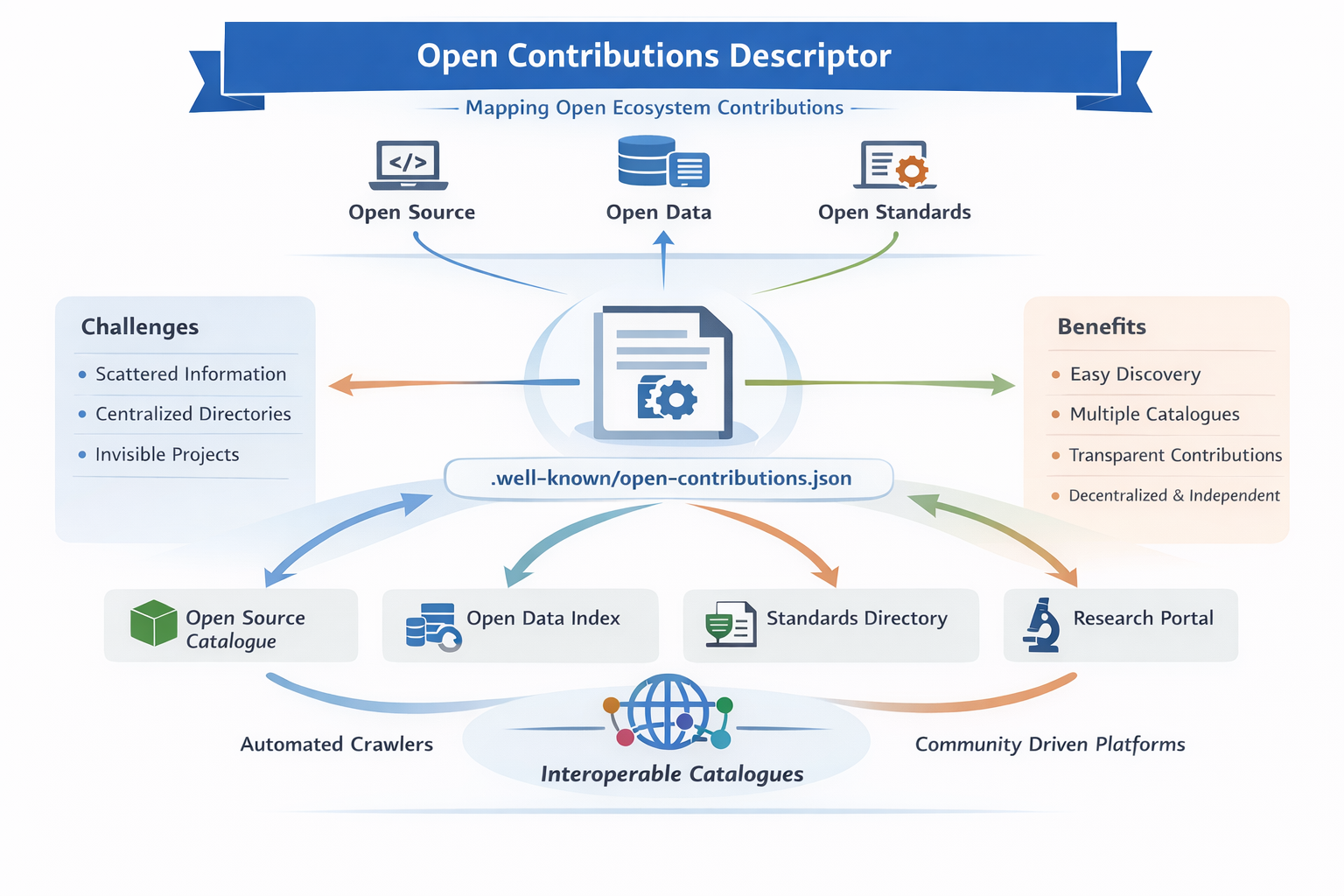
The Open Contributions Descriptor (OCD) is an open, machine-readable JSON format that lets an organization publish a single, structured description of how it contributes to the open ecosystem.
Instead of scattering information across repository READMEs, standards portals, data catalogs, and policy pages, OCD provides one canonical document that tools and people can discover and consume.
Core idea
OCD gives every organization a predictable discovery endpoint:
https://<organization-domain>/.well-known/open-contributions.json
This makes openness easier to index and automate for catalogs, dashboards, procurement checks, ecosystem mapping, and public transparency efforts.
What can be described
An OCD document can cover multiple domains of openness:
- Organization metadata (identity, links, high-level context)
- Open source software projects (repositories, licenses, status, docs, governance)
- Open data publications (datasets, formats, licenses, APIs)
- Open standards participation (working groups, drafts, implementations)
- Machine-consumable interfaces (for example OpenAPI descriptors)
Why this matters
Organizations can be open in many ways, but discovery is often fragmented and hard to automate. OCD helps by making openness:
- Discoverable: one well-known URL
- Interoperable: shared schema and expected fields
- Automatable: easy to validate, ingest, and monitor
This approach is inspired by established metadata practices such as security.txt, OpenAPI, SBOM ecosystems, and Mozilla’s historical contribute.json initiative.
Practical implementation guide
- Create your descriptor in JSON.
- Validate it against the official schema.
- Publish it under
/.well-known/open-contributions.jsonon your primary domain. - Link to source repositories and governance docs so consumers can verify and navigate quickly.
- Keep lifecycle fields up to date (active, archived, disabled, etc.).
Minimal example
{
  "organization": {
    "name": "Example Org",
    "domain": "example.org"
  },
  "openSource": [
    {
      "name": "example-project",
      "repository": "https://github.com/example-org/example-project",
      "license": "MIT",
      "status": "active"
    }
  ]
}
Specification and resources
- Project repository: ossbase-org/Open-Contributions-Descriptor
- Format description: format.md
- JSON Schema: ocd-schema.json
- Example discovery endpoint (MISP): https://www.misp-project.org/.well-known/open-contributions.json
- Online editor and viewer: Open Contributions Descriptor Viewer and Editor
- Open Contributions Descriptor — or how to map your contribution in open source, open data, and open standards
Compatibility and extensions
The format is designed for forward compatibility:
- Consumers should ignore unknown fields.
- Publishers may add organization-specific data under
extensions.
This keeps the core interoperable while allowing experimentation and ecosystem-specific metadata.